Tuesday, October 30, 2007

Virtualization – The Next Generation

There are a number of case studies that show that server virtualization and consolidation provides significantly higher utilization of assets. Cost savings occur not only due to direct equipment costs, but also due to savings in software licensing costs, rack space and data center usage and power. Over 75% of large enterprises now use at least some method of server virtualization in their data-centers.

On the client too, desktop virtualization eliminates the need for testing a home-grown application for compatibility and qualification with a number of desktop operating systems, and makes desktop OS migration significantly easier due to fewer dependencies on additional application development and testing efforts.

However, the ever-increasing drive towards more efficient computing organizations will undoubtedly take enterprise IT computing to the next steps in virtualization – where computing, storage and networks are all able to anticipate and re-configure themselves according to demand for specific computing resources.

Dynamic provisioning – where a virtual server is configured as needed, will enable IT managers in capacity planning using averages and medians instead of peaks in usage – which typically occur less than 10 hours in a year. For instance, additional e-commerce virtual servers would be instantiated dynamically on Black Friday, which usually sees the highest sales in a calendar year, and additional customer service virtual servers would be provisioned automatically to handle returns after new year for an e-commerce business.

Demand Orchestration - Additionally, business process configuration and management software will also be intelligent enough to orchestrate demand to balance the need to maintain business SLA's and optimal efficiency. For instance, a line of business file export could be configured to run any time between 12am and 4am, and will be scheduled intelligently between those times by a scheduler using historic data. Intelligent scheduling of computing demand will enable higher utilization due to more uniform usage.

Exciting times are ahead for IT efficiency in general, with virtualization evolving to squeeze more out of infrastructural investments.

Monday, October 29, 2007

Social Networking and Customer Acquisition costs

I was infected with a virus this week. After a few futile attempts to fight ghosts being thrown at me and offers of beer, I succumbed and installed SuperPoke! and to get even, sent a few vampires after those people. Nicholas Carr talks eloquently about vampires and social networks and observes that we welcome these social networks to be part of our lives.

Many blogs and news articles have commented on how Facebook would be able to use profile information to target ads more effectively than ever. While this may certainly be true, I think that peer pressure and peer recommendations are going to drive the next generation of marketing efforts far more effectively than super-targeted campaigns using profile information. This approach is currently far cheaper than other means of customer acquisition, and stickiness is likely to be greater because it is enforced softly by the your peer group.

First, for most of the population the need for affiliation is far more than the need for power or achievement. Analysis of qualitative information around us (I can't seem to find quantitative data with nAff, nPow or nAch scores for US subjects using McClelland's Thematic Apperception Test and inexperienced in conducting such a test. If anyone has some information, please post in comments below or email me) like houses in a sub-division, dress codes, cars in a neighborhood etc. look alike not only because of formal rules, but also because of informal social pressure.

Additionally, cost of web-traffic is growing. For adwords, or paid search, the most used keywords are fairly expensive, and less used search keywords need a marketing specialist to manage a campaign. Affiliate marketing rates for traffic are anywhere from 4%-15% of revenues. With shrinking margins, this cost is often prohibitive for product companies.

Firms have already realized this, and product companies are increasingly moving to own communities (Johnson and Johnson's purchase of Mayasmom and Reliance's launch of bigadda.com are some examples). BuyCostumes has benefited by this trend by writing a Facebook application and saving significantly on costs of customer acquisition.

All this leads me to think that the next logical step for Facebook is offer a valuable service to product companies–set up Owner Clubs for products and charge product companies for this service.

Wednesday, October 17, 2007

Are Companies Spending too much on IT?

Most IT managers and executives are likely to be creating their 2008 IT budget this time of the year. As companies prepare for an economic slowdown and are looking to reduce operating expenses, IT executives may be hard-pressed to explain any increases in IT spend.

I looked at IT areas where companies are currently spending money, and where there may be room to reduce IT operating expenses without creating investing in large CAPEX projects.
According to META in 2004, the financial services industry is well above overall averages, with projected IT spending of six percent of revenue in 2005, compared to an average of just over four percent and projected spend of 13 percent of operational expenses, compared to an average of five percent.

Gartner surveys say insurance companies in the US spent 2 to 4 percent of their annual revenues on IT expenses in 2006.
Surprisingly, insurance companies were quoted as saying that 65% of their IT expenses were "to keep the lights on." The large amount spent in running the engine leaves few resources for strategic projects that can actually help increase company revenues. Here are a few areas where executives can reduce their IT spending.

Do you really need those servers?

Additional resources come with huge hidden costs. For example, software licensing, data-center space, maintenance contracts and additional system or network administrators needed to manage the product, may end up making a bigger dent on your IT budget than you intended.

See if you can move applications to servers to improve utilization, or use virtualization to squeeze more out of your hardware. Also, using virtualization may mean that you can get rid of some OS licenses altogether. For instance Weblogic runs directly on the hypervisor, and other applications that run on Java VM's may be able to do so as well.

Better Application Maintenance processes

Ensure that you have a documented application development process. Use EPF or Visual Studio Team system to have an integrated approach to application lifecycle management. Enforcing a process ensures smaller learning curves, and consistency in estimates and process when interacting with other departments. Ultimately, this saves time and reduces confusion and risks. In addition, since the process is documented and enforced by the system, you can continually improve process and ensure that every one in the application development team follows it.

Use PPM to determine what Projects to execute
Unfortunately, most executives have more positive NPV projects than the budget will allow (and raising additional capital for projects, while theoretically sound, may not be likely in practice due to transaction costs). If you already have a good system for evaluating business cases, tracking projects, quantifying risks - use your PPM system to monitor and reassess your priorities as the time goes by. Sometimes, it makes sense to nix a project that continues to be on time and on budget if it is no longer as important. If you don't have such a system to track projects, this may be a good time to start. Serena's Mariner or Microsoft Project Portfolio Server are best implemented by professional services or if you have the $$, by consulting companies who have done this many times before.

"Lights-on" Operations
Are you relying on people for operations that can be automated? For instance, diagnosing most issues like batch processes not running or password resets do not require a technical support person. Look at issue logs over the last 6-12 months and identify the issues that were most frequent and required signficant time to fix. Look for opportunities to automate diagnosing and fixing these simple but time-consuming problems using simple scripts or use products like iConclude (now part of HP).

Tuesday, October 16, 2007

The Malaise at Microsoft

In a business school case (Rohm & Haas), we learned about how channels of distribution were critical to a new product's success. I have added a brief description of the case below.
Joan Macey, Rohm and Haas' market manager for Metalworking Fluid Biocides, found that sales of a new biocide, Kathon MWX, was utterly disappointing. This was all the more puzzling since sales of her other product--Kathon 886 MW, a liquid biocide used only in large-capacity tanks--was well on target and held a steady 30% market share. In May 1984, about five months after the new product was launched, Joan Macey was reviewing her entire marketing strategy with a view to bringing Kathon MWX sales closer to target. Of particular concern to her were the distribution and communication strategies used for the new product.
Designed for Channel, not the end-user. The better product apparently cannibalized strong service revenue retailers were getting, and retailers really didn't have any incentive to sell the new product. Obviously, Microsoft has learned this lesson too well. That is the problem. It is obviously not enough that a product exist to help players in the value chain capture value, it has to create substantial value to the customer too.

Products don't solve a problem: Most products (including Vista) primarily seem to be designed to push more products and services to customers who really don't see a problem being solved.

Products create problems. In fact, most people I know have gone back to XP because all their software and peripherals (Camcorder, Palm software etc.) work with XP but not with Vista. These are people who prefer function to form.

Advice to product managers: talk to end users for product requirements, not just to channel partners.

How much is it again? Licensing is confusing. Now, that is an understatement. Because a lot of Microsoft products are sold through channel, Microsoft has to list really ridiculous list prices for their software. Other software vendors like Oracle also do so, but Oracle primarily deals with large enterprises, whereas Microsoft has a lot of small business customers. If I don't understand pricing, as an IT manager, I will go to a vendor who has a more transparent pricing model.
The licensing tool is an attempt to help with your pricing confusion and perhaps anchor a ridiculously high price as a reference point for you to begin bargaining.

Segmentation Gone Wild
Microsoft Dynamics, after several confusing name changes, has 7 products and each product has an average of 3 editions. Not only is this challenging for the customer to navigate through, it is challenging for the sales staff who has to be up to date on the features of each of those products. Is it really cost-effective to extract every ounce (or more) of value from your customers? Or is it poor post-merger integration?

Peanut Butter with your OS?
Yahoo executive Brad Garlinghouse wrote the Peanut Butter manifesto for Yahoo, but it applies to Microsoft as well. The software maker recently launched Real Live Moms, a Live Spaces site that exhorts moms to be "the most spirited mom in the block" (sic) and other spaces to promote its "community." It may be time for a talk about the problem of spreading resources too thin and shoddy execution on products.

Outlook: I'm moving to GAPE!
As SAAS offerings like Google Applications Premier Edition are beginning to provide rich functionality, avoid issues like local storage, and provide a clear pricing structure ($50/user annually), I expect more small businesses to move to such products. Also, improvements to Google Gears may take care of times when your network go offline for brief periods.

Monday, April 02, 2007

Understanding web-consumer psychology through Google Data

Google now collects vast amounts of consumer behavior data. Most obvious among the data being collected is search keywords.

By offering Google Analytics for free, Google is able to collect data from other sites that users visit, and is able to establish a pattern of visits for a particular visitor. For instance, Google will be able to determine what

Saturday, September 16, 2006

Not IT - Are railroad companies the next private equity target?

Private equity firms, with a significant amount of capital to invest, highly incentivized managers (in case of buyouts like Sungard), the ability to avoid the cost of being a publicly listed, and the opportunity to extract operational efficiencies - are all reasons for the increased number of buyouts by private equity firms.

Typically, private equity firms are attracted to industries with consistent cashflows, low volatility (beta less than 1) , low debt (Debt less than 50% of capital) and high dividends. The railroad industry ( BNI, NSC, UNP) fits right into this set of specifications, and their enterprise values (market value of debt + market value of equity) are in the $24bn - $30bn range, an size that a consortium of PE firms can easily digest.

In addition, cash flows in this industry are strong, coupled with gross margins close to 40%. Railroads have a greater efficiency than road transport - and higher fuel costs are likely to make railroads cheaper than shipping by road. Levered beta for this industry (with 40% D/K ratio) is 0.9.

Stock values in the transportation sector have in general weighed down by high fuel prices, and railroads may be a good buying opportunity for PE firms.

Name
Burlington Northern Santa Fe Corp. CANADIAN NATL RAILWAY CSX Corp. Norfolk Southern Corp. Union Pacific Corp.
Industry Railroads Railroads Railroads Railroads Railroads
Current Share Price 69.82 41.02 31.61 43.05 83.80
Market Value $25,272 mil $21,851 mil $14,020 mil $18,711 mil $22,571 mil
Revenues $14,031 mil $6,507 mil $9,096 mil $9,107 mil $14,715 mil
Net Earnings $1,724 mil $1,684 mil $1,036 mil $1,343 mil $1,366 mil
5-yr. Sales Growth 8.24% 13.84% 1.41% 7.49% 2.89%
5-yr. Earnings Growth 15.23% 35.48% 25.08% 31.49% -0.53%
Net Profit Margin 12.30% 25.90% 11.40% 14.70% 9.30%
Short Interest 1.3 1.6 1.4 0.8 1.2
Est. EPS Growth Rate 15.3% 14.3% 16.1% 14.4% 15.6%
Forward P/E 14.1 14.2 14.4 12.9 15.0
PEG 0.92 1.00 0.89 0.89 0.96
Price/Sales 1.8 3.4 1.6 2.0 1.5
Price/Cash Flow 10.2 10.2 8.3 10.4 9.7
Price/Book 2.5 2.6 1.6 1.9 1.6
ROE 17.5% 22.2% 12.7% 14.2% 9.8%
ROA 5.7% 9.0% 4.3% 5.2% 3.8%
Dividend $1.00 $0.59 $0.40 $0.72 $1.20
Dividend Yield 1.43% 1.44% 1.27% 1.67% 1.43%
Payout Ratio 16.8% 16.6% 11.6% 18.1% 23.7%
Total Return (12-mos.) 18.2% 17.1% 37.7% 7.7% 18.5%
Total Return (3-yr.) 149.4% 143.4% 121.6% 140.4% 50.2%
Beta 0.8 1.1 1.0 0.9 0.8
% Off 52-wk. High -20.65% -19.84% -15.32% -25.40% -14.04%
% Above 52-wk. Low 26.07% 21.54% 48.06% 16.29% 25.28%
On Balance Volume Index 61 59 67 46 82

Tuesday, August 29, 2006

The resurgence of Java

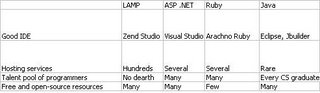
The majority of new websites (Web 2.0) use the LAMP stack, and other popular development platforms are ASP .NET and more recently, Ruby on Rails. Has Java seen its heyday?

Amazon's EC2, Google's Web Toolkit and Sun's open sourcing of Java may finally make economically feasible for web-companies to develop in Java.

For a development platform to be successful among web startups, it should have
1. A good IDE,
2. A variety of hosting services
3. A talent pool of programmers
4. Free code-samples and ready to use open-source software that users can customize.


While ASP .net and LAMP meet all these criteria, Java has always been tough to adopt because there weren't any cheap hosting services for a bootstrapped company to use.

Thanks to Amazon, a good language can now be used for things other than enterprise middleware services.

Also, Google's Web Toolkit now makes it possible for developers to develop web UI's using Java, and then convert them to Javascript.

So, if I could host applications like Daffodil CRM in an Amazon Elastic Cloud, and get it customized and integrated with my Web 2.0 website (at $12/hour), use one free development platform to develop a website that anyone with a CS degree should be familiar with, using Java finally makes economic sense.

I expect Java to add some caffeine to Web 2.0


Friday, June 09, 2006

Is Google entering Salesforce’s backyard?

Some products, like Google Sets, graduating from Google Labs may seem the esoteric. However, all these products fit a larger offering Google is building – a highly flexible set of application components with can be easily integrated into an application of your choice.

Applications or components include email, online calendars, spreadsheets, online document processing etc. But when combined together – these provide a significant productivity boost for customers. For instance, when I get a tracking number from an order I placed, Gmail automatically detects the string as a UPS tracking number and provides a link to check the status of the package. It is also able to detect a meeting request or an address and show me the appropriate links (like “Add to Calendar” or “View map”).
Gmail conversation threading and labels provide the ability to track chains of conversations. Also, Google Analytics provides a fantastic system to view Web leads and look at your sales-funnel, and you could get the features of a basic CRM for free with Google products. Granted that most of the products are still in Beta, but Salesforce has had some outages as well. One missing pieceGoogle Proxy authentication, which seems imminent, when available will make software development over Google Services easier and undermine some of Salesforce’s value proposition to ISVs.

Meanwhile, Salesforce has probably anticipated and is reacting to this strategic threat with AppExchange. Just as fries or soda are always easier to sell with the burger... by providing a platform with rich services, the AppExchange platform is helping ISV’s by reducing the friction in the sales and product development process, and increasing value of both the Salesforce platform and the ISV’s product to customers by providing a seamless interface. Of course, the markets segments each company is targeting currently are very different, with Google targeting individual and small business e-commerce companies, and Salesforce targeting the SMB and the enterprise marketplace. But with the projected high growth rates of both companies and not-so-high growth rates of the CRM market - competition is inevitable.

Passport 2.0?

One of the challenges facing Web 2.0 companies today is the friction due to required signups. You typically provide an email address and a password to create an account, and you get a confirmation email with an activation code. As a visitor to the website, this causes a significant amount of friction, and I looked into how we can eliminate this while ensuring that the website is able to provide features that will not be misused (for email or link spam)

Why do websites require accounts?


1.
To prevent misuse – Visitors without accounts can use the “email this article” feature to spam others. Alternatively, comment spam could be used to boost Pagerank.


2. To keep track of visitors and their information – Websites could also do this with cookies, but users have the ability to delete them.


3. To notify users of “Exciting new features” – This is a proven method of increasing web traffic.


4. To protect private information a user may have entered or other transactional information.

All these, or most of these functions can be accomplished by having one company manage ID’s for multiple websites. Like the Google Account or Microsoft Passport earlier, a OneID would make it easier for web users to get access to a lot of features on a website without the webmaster having to worry about the potential misuse by anonymous users.

Symantec is reported to be exploring this opportunity, and Google may be coming up with an Account authentication proxy. Several blogs, including ZDNet, point to this imminent launch.

The feature will be particularly useful for Google because they can look at what other sites a user visits, and will be able to better train their search algorithms to display to the user what they were looking for without having to visit 10 websites to get this information.

Is this the case of Google copying Microsoft?

Thursday, March 02, 2006

Metric madness causes google searches to be no longer as relevant

The Google search algorithm is a popularity contest of sorts, and Google uses links to the site from other sites as a proxy to measure this intangible attribute.

How Google works

PageRank Technology: PageRank performs an objective measurement of the importance of web pages by solving an equation of more than 500 million variables and 2 billion terms. Instead of counting direct links, PageRank interprets a link from Page A to Page B as a vote for Page B by Page A. PageRank then assesses a page's importance by the number of votes it receives.

Consequently, people who want their sites to get a higher pagerank know exactly what to do - get reciprocal links, get links from the more well-known sites, or write poor quality blogs with every tenth or fifteenth phrase being the topic the webmaster wants to promote.

And thus, the metric is separated from the underlying attribute it strongly correlated to earlier. Google search is no longer as good as it used to be, because the motivation to link to other sites is not solely whether you like the other site's content.

So, why is Google still successful? Other search engines do not have the simple look and feel we have all grown so accustomed to...

Update: I hadn't realized that Nick Carr and the Wall Street Journal wrote about this issue on March 1.

Tuesday, February 28, 2006

Consolidate or go for grid of cheap servers?

Most fortune-500 companies have already done some consolidation. The benefits of server consolidation have been huge - the tens or hundreds of servers, each with different patch levels and service contracts contributing to low utilizations have been replaced by a few high-end servers. Nicholas Carr, in his blog asks if the server industry will suffer as a result of higher CPU utilization (resulting either from virtualization or consolidation)?

SAP's Charles Zedlewski provides a good counterargument, why the server industry will be ok after all.

The real metrics that organizations should consider are
1. Costs per processing unit,
2. Volatility of computing demand.

In the long term, enterprises of the future will go with a limited number of highly consolidated servers running some virtualization software, yielding about 60%-70% in utilization, with additional computing power available on-demand to run complex statistical and marketing programs, provided by OEM vendors like Sun, IBM or other providers using generic hardware.

I wouldn't be too worried about any drastic reduction in computing demand, simply because firms would (hopefully) buy this additional lower cost processing capacity to make better business decisions. The only server manufacturers who would truly go away are server divisions or companies that make expensive, generic hardware (Dell, HP?).

Space and power - the drivers for hardware design

Once upon a time, hardware and software costs were a significant portion of a company's IT budget. As costs of harware and software reduced, companies are more concerned about data-center costs, which are now a significant portion of IT budgets. Some of these costs are also incurred by other departments in the company, and facility managers have to take these factors into account when desgning a data-center.

Data-center costs are - real estate costs, power costs for HVAC and computer equipment.

Sunday, February 26, 2006

The IT eco-system

Here is a pictorial representation of the IT ecosystem I put together. I will use this as a basis for the next few posts.


Wednesday, February 22, 2006

SAP and Microsoft

Two software leaders SAP and Microsoft, are slowly reentering the On-demand marketplace. These two software giants have not targeted the early adopters in the Gartner Hype cycle, and usually have enter the field later than most other cutting edge ISVs. Consequently, they have used their deeper pockets and other resources to steadily erode marketshare of other incumbents in the field.

Also, while SAP has provided some limited resources to open source projects like SAPdb, and Microsoft may be forced to license its software in the EU, both companies have largely eschewed open-source and continue to rely on traditional software business models.

Both companies a strong partner program to complementors (ISVs, distributors, systems integrators and Value added resellers) significant incentives to partner.

Are they competitors or do they complement each other?

Currently, SAP and Microsoft products largely complement each other. SAP and Microsoft are also collaborating in Mendocino to integrate back-office ERP with front-office Microsoft Office products, possibly using .Net and NetWeaver.

However, Microsoft, with its newly renamed Dynamics products is targeting the small and medium business (SMB) ERP markets, the same market that SAP is increasingly focused on to increase its growth.

We will know in the next few months whether the Dynamics products start gaining traction in the marketplace or whether a the product requires a lot more than a new name to be successful.

Tuesday, February 21, 2006

Salesforce earnings 2/22

Salesforce has undoubtedly been a phenomenal success - with a value-proposition targeted at companies' frustration with lengthy CRM installations. Well, once the installation is complete, customers are only going to be satisfied if the product is fundamentally feature-rich. Also, customers in a subscription model are always going to look at the pricing of comparative products.

With Microsoft announcing its entry into the CRM market, SAP entering the On-demand CRM space, and open source offerings from Daffodil and SugarCRM , the added-value provided by Salesforce has significantly diminished. Salesforce has been forced to add value in other areas - which it has tried to do with the Appexchange platform, but I cannot think of any serious venture-funded ISV developing software to be solely on the Appforce platform, especially with so many other CRM products entering the market.


Service delivery has also been a problem in the recent past, with two high-profile outages, after which the company has started disclosing root-cause and service availability at trust.salesforce.com , but not before several blogs started complaining about the lack of visibility and corporate IT departments going into the "I told you so mode".

While the quality of earnings is high due to the subscription model (since customers provide recurring revenue and a huge attrition is unlikely to occur), I am very skeptical that Salesforce deserves a P/E ratio of 151 when even SAP and Microsoft are trading at more modest multiples.

Monday, February 20, 2006

Dell's poor outlook for next year

Dell's performance as a cost-leader using a direct-sales channel is being threatened. As other manufacturers have gained significant efficiency in manufacturing, they are able to manufacture and sell higher quality products to customers. VAR Business provides a good overview of Dell's malaise. As VARs find more ways to beat Dell , we haven't seen any major changes in Dell's strategy apart from some blathering about manufacturing computers with AMD chips .

With enterprise markets tending to move more towards HP and Lenovo, and consumers switching towards whitebox computers, Dell must work fast to recapture these market segments where it has been most successful in the past.

At least, Rollins isn't busy giving away hardware and chuckling at competitors as they take market share away.

Sunset?

Sun Microsystems' future does not look very bright. They have "successfully" opensourced the Solaris operating system with 4 million downloads, and more recently have started giving away Niagara servers on free trials.

While open-source and try-before-you-buy hardware may build communities and be very good for the customer, I fail to see how any of this will make Sun any money. More likely, if there is a widespread adoption of Solaris, it will be on whitebox servers.
Sunfire servers may be state of the art and may only sip juice, but they more than 3 times more expensive than whitebox servers.

Sun has also been notorious for failing to make money on good products (Java?). I see Sun continuing to dig a deeper hole for itself in the next few quarters, until a company with money and focus on monetization(maybe Oracle) buys them.

It is also funny to see Schwartz chuckling at HP.

"We all enjoyed the site HP put up to promote Sun's Niagara announcement - it's worth a good chuckle."


Only time will tell who has the last laugh.